Wednesday, 7 May 2014

Splash and relax!

During the last week we have installed a rather fetching swimming pool at the Nautical Museum, supplied with great efficiency by UK firm Splash and Relax. The pool is filled with seawater pumped from the dock. I have now done some splashing (though not much relaxing) as I submerged the large archaeological finds from George Quayle's dock in it. These include pig iron ballast, ships planking, structural timbers and wrought iron parts from unidentified machinery, a hatchway or door, and a great variety of unidentified, worked timber.


Intex pool, with views of Castle Rushen

Me putting timber finds into the pool

Some of the packages refused to sink....

The pool, full of archaeological finds

I should add that the pool is sitting in the stable yard, a part of the complex that isn't accessible to the public. Whilst it's certainly not in keeping with the Georgian architecture surrounding it, it is only a temporary installation! Once we've had a chance, this summer, to review the finds, we'll build a more discreet and permanent tank in the adjacent cellar to house them. If we are lucky there'll be a bit of summer remaining so that we can reuse the pool for the Staff Swimming Gala (just kidding).

Wednesday, 9 April 2014

The end of the dock dig

Last Friday Oxford Archaeology North completed the archaeological excavation of George Quayle's 18th century dock at the Nautical Museum, Castletown. Readers of previous posts on this blog will already know that our expectations had been quickly confounded as soon as the first skip of spoil was full. Now, 160 tonnes of spoil later, what did they find, and what's next for Quayle's boat house?

The excavated dock, looking towards the sea arch

In this picture you can clearly see the outlines of the dock. It's under at least a foot of water at all times. The remains of the inner gate are slumped at the end - we had to stop excavating at that point in case the rubble infill under the arch began to collapse upon us. It's just one of several things that remain to be dealt with. You can see submerged timbers on the left side of the picture: the dock was neatly lined with timber, but most of the lining has gone. Less easy to see are the beautifully laid stone flags that line the base of the dock. One of my first jobs is to plan the construction of a temporary scaffold platform to pull Peggy out upon (for more information on this see my previous posts from early 2013). Cue further meetings with scaffolders and engineers.

In the foreground of the picture is a jumble of wheels and other objects. These are all fused together.

Unidentified, fused mass of machinery and rubbish

You'll no doubt be able to make out a pair of cast iron wheels as well as any number of unidentified submerged objects (today we'll call these USO's) along with nineteenth century bottles. The whole pile is sitting on a layer of wood chips and saw dust on the bottom of the dock. It would appear to be the remains of some kind of machinery or contraption, and because of it's archaeological context we can date it to the Quayle period. It seems to have been dumped in the dock after the  latter had fallen into disuse and disrepair. At some point not long after somebody dumped a whole load of cement mortar or plaster on top of it - it's this that has fused the whole lot together. It looks to me like Portland cement mortar - proper analysis might confirm this - and this would be very interesting since Portland cement was not patented until 1824. Traditional lime mortars, such as those used to build the dock, don't set when wet.

Fused mass with cement

I am currently working on a plan to remove this mass of stuff, separate the pieces and record it. I also have to find a temporary home for the 1000 other archaeological finds. We are looking at going through all the finds this summer, possibly using local volunteers to help. Allison Fox, our Archaeology Curator, will be instrumental in this phase of the project.

Friday, 21 March 2014

Archaeological Dig Week 3

Oxford Archaeology North are continuing to dig George Quayle's private dock and, at the time of writing, are at or near the bottom. We have learned an enormous amount but, predictably, we are faced with more questions than we currently have answers for!
The main findings so far:
  • The dock was used as a tip through the 19th century. There's a layer of 'night soil' (contents of chamber pots etc.) that has preserved a lot of items below it remarkably well. This is because there was very little oxygen filtering through.
  • The dock retains a metre or so of water even at low tide - we think this is because there's a 'lip' at the dock entrance. This too has contributed to the preservation of some objects.
  • We have excavated many more finds than we had anticipated, including a large number of rigging blocks and pulleys, glass and china. Caroline has also found parts discarded from Peggy during the boat's conversion to the form we see today. This shows, remarkably, that Peggy was worked upon in this very dock.
  • There are some very strange timbers, wrought iron artefacts and leather straps emerging. Plenty of evidence, in short, of George Quayle's ingenious imagination at work. At the moment we have no idea what we are looking at, but we have faith that the end of the dig will enlighten us.
  • The depth of the dock is greater than we thought and that has meant the dig has overrun. We now hope to complete the excavation by the end of March 2014.
The conditions in which the archaeologists are working are truly very nasty, as this photo, taken at low tide, shows. Aside from the wind and rain, the dock never fully empties.

East side of the dock at low tide

We are having trouble finding room for all the finds, many of which will have to be kept wet to stop them from falling apart.

Studded brass strapping - from a carriage?

One of several wet finds tanks


Our fragile wet finds tank

Thursday, 6 March 2014

Archaeological Dig Week 2

Caroline Raynor and her archaeologist colleagues from Oxford Archaeology North are making steady progress with their excavation of George Quayle's boat yard.
They ended last week contemplating a test pit they'd dug next to the boat cellar doors. We were surprised to find, instead of the expected slipway, a deep dock. Surprised, but not too much so because we are aware that workmen were employed in 1950 to level the boat yard but were forced to abandon the attempt because they claimed to have encountered a giant hole. The reference to this episode comes from a letter from the then Director of the Manx Museum and National Trust (the precursor to Manx National Heritage) Basil Megaw, to the dignitary he had invited to preside over the opening of the new Nautical Museum in 1951. We can now make sense of Megaw's letter. The test pit was pretty deep before OAN too had to stop digging as they had begun to undermine the scaffold platform they'd had built. So, dock - not slipway.

From the test pit have emerged a number of very interesting and well-preserved timbers strongly reminiscent of boat knees. For these and other finds I have installed a tank of sea water in the cellar - it's important to keep them wet until such time as we can decide their fate. Caroline has already drawn and photographed everything she has found so far.


Click to enlarge
Caroline in front of George Quayle's sea arch

In the photo can clearly be seen the shallow archway exit from the dock, and the sides of the dock, too. Less easy to see are timbers under the arch, the remains of a very substantial wooden doorway. Behind them you can see how the archway has been carefully blocked with a dry stone wall of squared blocks. 
Caroline is standing at least five feet or 1.5 metres from the bottom. Our current estimate stands at 130 tonnes of spoil from the dig as a whole. She has identified 29 distinct strata so far, all composed of nineteenth-century rubbish, including a great variety of broken crockery and other such miscellaneous items.
Because of the obvious eventual depth of the excavation we now know the dig will be somewhat more tricky and time consuming than might otherwise have been the case. This is mainly because the scaffolding platform and ramp we are using to get the mini digger and dump truck in and out of the yard will need to be altered more times than we'd originally hoped.

Wednesday, 26 February 2014

Archaeological Dig, Week 1

Caroline Raynor from Oxford Archaeology North spared us some of her time this morning, during a break in the rain, to tell us about the substantial progress she and her colleague have made over the past three days.
We are currently expecting to unearth George Quayle's slipway and perhaps, too, the remains of mechanical contraptions and of structures such as George's faux boat deck. So far Caroline has identified six or seven distinct layers of deposits, and that's just in the first 75 centimetres (two and a half feet, if you prefer) of digging! This suggests that the slipway may have been used as a dump on numerous occasions.
More interestingly she has uncovered some interesting features of the building itself. Chief amongst these is that we can now see the head of George's sea gateway. It's located in a wall that is 2.5 metres (eight feet) thick. We had thought the lowest part of that wall was just a rough and relatively recent buttress, but that's clearly not the case. So it seems Peggy would have been pulled out of the sea and up a tunnel...


Dig in progress: L - R: Steve Blackford; Head of Properties at MNH; Caroline Raynor from OAN North; Andy Johnson Field Archaeologist at MNH; and Roland Ardern-Corris, MNH technician.


The sea arch emerges....


Andy inspects a recently discovered buttress


Friday, 21 February 2014

Industrial archaeology at the Nautical Museum

The archaeologists from Oxford Archaeology North have arrived on the island and are setting up their equipment ready to begin digging George Quayle's slipway. To prepare for this, local building firm Ryzack Construction Limited have been hard at work removing the stairways and balconies from the area.

Copyright MNH
The yard/ slipway cleared for excavation


Plant hire specialist JCK have created a bridge from scaffolding that will allow a mini digger to remove spoil from the yard...... 

Access platform for mini digger
The view of the boathouse and the platform for the mini digger

 ...... and out through the disused adjacent cellar. Ryzack Construction opened up doorway for us that had been blocked in the 1950's or 1960's. This will be the route the archaeologists use to remove the spoil from their dig, estimated at 100 tonnes (!).

The new doorway. The yard/ slipway is on the left, Quayle's stable yard on the right


This is an unpublished sketch of George Quayle's coach yard from the Manx National Collection IOMMM 1954-5420 signed R.S. Buckingham, 1941. In it you can clearly see, amongst other things, an opening, lower right, giving on to the cellar, or undercroft. This is the opening we have re-established. We have been very careful to take into account Paul Drury's work on the relative significance of the modern additions to Quayle's buildings.

IOMMM 1954-5420 'Harness Rooms, Bridge House, Castletown, April 1941


And this is how the same view appears right now.....

Harness rooms and cellar, from the stable yard

Monday, 6 January 2014

New Year, new flood


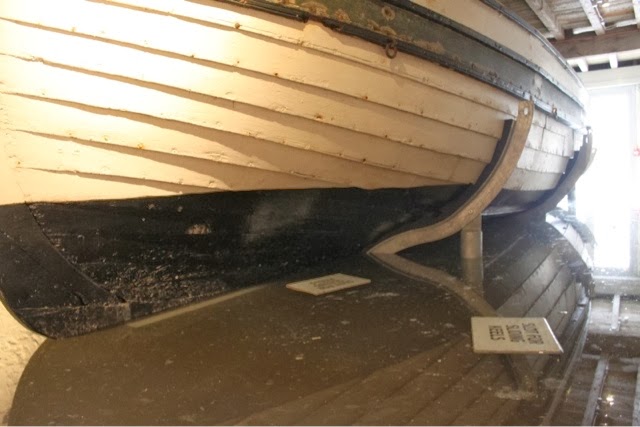
As I mentioned in my penultimate post, the Spring tides are wreaking havoc on the Isle of Man this Winter. The flooding in the boat cellar this week has been the worst for many years, aided by the strong south-westerly winds. For all the reasons I have written about before, having the boat in contact with, or under, seawater is little short of disastrous. Unfortunately, due to the design and construction of the boat house, there was absolutely nothing we could do to stop the water getting in (such as sand-bagging for example). The results of this week’s tidal flooding serve yet again to underscore the urgency of what we are trying to achieve.


Here are some pictures showing waves breaking over the boat yard and the cellar and boat full off water (it can't float because it's full of holes!).


On a more positive note we have received planning consent for the alteration to the site necessary to remove Peggy. Oxford Archaeology North has been invited to undertake the archaeological dig that will free Peggy from her watery prison. As soon as the tides goes out they can get started!