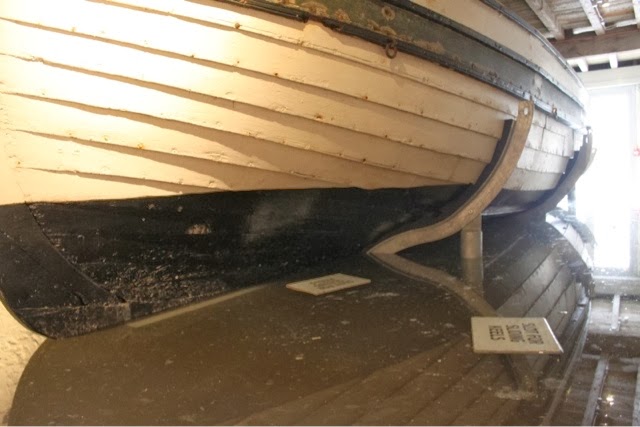
Here are some pictures showing waves breaking over the boat yard and the cellar and boat full off water (it can't float because it's full of holes!).
This blog will follow the progress of the project to conserve and record the 18th century yacht, Peggy.
Monday, 6 January 2014
New Year, new flood
Friday, 6 December 2013
Winding gear no more
For many years it had been assumed that the four drums with cog wheels were part of an elaborate winding system for pulling Peggy into the cellar. We now believe this not to be true. There are in fact anchorage points for blocks and tackle set into the cellar floor at the back of the room, and its far more likely these were what Quayle’s men used to pull the boat from the sea to the cellar.
Paul Drury is of the opinion that the drums are more probably parts salvaged from George Quayle’s flax mill, which had been spectacularly successful before banking and political interests came to dominate his public life. In 1793 George was awarded a Silver Medal by the Royal Society in London for an invention designed to make the flow of water to a mill wheel more even, regardless of how much water was held in the feed reservoir. Here’s a picture of the winning design.
Flood!
During the past 24 hours the British Isles have been subjected to tidal surges and a Winter storm. What was described yesterday on BBC Radio 4 as “a mound of water” pushing up from the South met Northerly winds head-on. Worst affected was the East coast of England, but here on the Isle of Man, half way between England and Ireland, we also experienced high water.

High tide yesterday saw me down in the boat cellar taking pictures of Peggy. Being midday, this was a rare opportunity to see what a high tide with a storm surge can do. As you can see from the photographs, the result wasn’t pretty although, thankfully, the seawater rose just short of Peggy herself by two or three centimetres. In March 2015 a tide is predicted sixty seven centimetres higher still than that we saw yesterday. Such a tide would fill Peggy one third full of seawater (she won’t float because she’s full of small holes).

These pictures illustrate graphically why removing Peggy from the cellar before 2015 is such a high priority for Manx National Heritage.
Monday, 4 November 2013
Necessary hurdles
Since I last wrote on the blog my colleagues and I have met on site with the Conservation Officer and the Planning Department to discuss our intention to remove the contents of the yard (in front of the boat cellar; you'll recall this is necessary to allow us space to pull Peggy out of her cellar). Manx National Heritage is the Isle of Man's heritage agency and we have a strong lead role in upholding and promoting the statutory protection of historic buildings and sites. We are very keen to ensure that we have complied with all the same legal requirements any private owner would be expected to comply with. We've taken advice from structural engineers about the likely consequences of removing the infill from the yard, and they didn't identify any risks to the surrounding structures. We've been advised to submit a planning application for the work, and we're hopeful of a favourable verdict. We have also appointed a Project Manager to oversee the practicalities of health and safety and other technical matters for the excavation of the yard and, later, the removal of the boat. We are now ready to send out the job brief to archaeological contractors.
If this all seems rather dry and tedious, that's because it is! However, we are determined to plan every aspect of the conservation works to the highest standard we can. We want the various stages to run smoothly, and most of all we need the collective consent of our colleagues and friends on the island and further afield.
We are hoping to begin the archaeological excavation in January for completion in March 2014.
Meanwhile we are continuing our search for a suitable conservation facility for Peggy on the island. We have been working further with Paul Drury (see previous post) to unravel the hidden history of George Quayle and his use of the site. We think now that Mr. Drurys' final report will be held back in order to incorporate any findings from the archaeological dig of the yard (or 'dock' or 'slipway'...).
Tuesday, 1 October 2013
Progress update
It's been some time since my last post on this blog because I have been unable to access my account! Readers may therefore be surprised to learn just how much has been happening.
The Drury MacPherson Partnership has been appointed to compile a conservation management plan covering the future of Peggy and of the Nautical Museum site. Paul Drury and his team have been hard at work on a comprehensive analysis and re-evaluation of the site and all related archive sources. They have turned up some astonishing facts about the buildings and the use to which they were put. We never knew, for example, that George Quayle's boat house extended, in the early part of the nineteenth century, over the dock in the form of a frigate deck (imagine that if you will!).
Meanwhile we have been writing a detailed brief for the archaeological excavation of the boat yard, a necessary precursor to the removal of the boat in 2014. We hope to have the dig completed early in the New Year. And we have also begun the search for a new building in which to put Peggy during the conservation phase, 2014-2019.
I shall try to post some of the laser metric survey drawings by James Brennan Associates.
Wednesday, 24 July 2013
Zetland and other maritime encounters
Last week I had the good fortune to visit the Zetland Lifeboat in Redcar. Zetland is a remarkable and venerable boat built in 1802, comparable in size to Peggy. She's the oldest surviving lifeboat in the world and her significance is attested to by her inclusion on the National Register of Historic Ships.
One of the most striking things is that the hull-form of Zetland - the traditional coble common right up the NE coast of England and into Scotland - can clearly be seen in modern fishing vessels nearby. It's a flat bottomed hull ideally suited to launching from sandy beaches. A peculiarity of Peggy is that she is possibly the last surviving example of the shallop hull form, the once ubiquitous workhorse of inshore waters in the NW and cousin to the cobles of the NE.
I also visited the Grace Darling coble (1818) which, by contrast, is displayed as the centrepiece of a purpose-built museum in Bamburgh, and HMS Trincomalee in Hartlepool, a man of war of the same date, now a fully-restored visitor attraction. Both visits were very interesting.
![]() |
| The Zetland lifeboat museum |
I was very well-looked after by the volunteer staff who run the museum in which she's housed, particularly by Fred Brunskill of the Friends of the Zetland Lifeboat. It was fascinating to learn of the problems faced by the custodians, so similar and so different to those we face with Peggy. The main difference is that Zetland has a sealed deck, making her hard to study. Lately, under some raised deck planking, they have been able to ascertain that the tarred buoyancy 'boxes', designed to keep her afloat in all seas, are substantially rotted. More similar to the Peggy is the historic building in which Zetland is housed - it will be challenging to say the least to reduce and maintain a lower level of humidity in the building than that which it enjoys naturally.
![]() |
| A modern coble on the sea front in Redcar |
One of the most striking things is that the hull-form of Zetland - the traditional coble common right up the NE coast of England and into Scotland - can clearly be seen in modern fishing vessels nearby. It's a flat bottomed hull ideally suited to launching from sandy beaches. A peculiarity of Peggy is that she is possibly the last surviving example of the shallop hull form, the once ubiquitous workhorse of inshore waters in the NW and cousin to the cobles of the NE.
I also visited the Grace Darling coble (1818) which, by contrast, is displayed as the centrepiece of a purpose-built museum in Bamburgh, and HMS Trincomalee in Hartlepool, a man of war of the same date, now a fully-restored visitor attraction. Both visits were very interesting.
![]() |
| HMS Trincomalee, a fully restored visitor attraction |
Phase 2 begins...
Though it has been a while since my last post, we have not otherwise been idle. Paul Drury of the Drury Macpherson Partnership has been working very hard on the compilation of a Conservation Management Plan for the Nautical Museum which incorporates, of course, George Quayle's boat house. His research includes not only a detailed study of the buildings, their history and origins, but also a systematic perusal of all the relevant archival sources. Paul and his team have already unearthed some fantastic and hitherto unrecognised material, such as plans and sketches in George Quayle's hand from around 1812. Paul is hoping to organise a seminar on matters arising from his research later this year, to which we hope to invite knowledgeable and interested parties.
Meanwhile, Andrew Johnson, MNH Field Archaeologist, has been drafting a brief for the archaeological excavation of the dock outside the cellar. We have, with Paul's help, hit upon a means of removing the c. 100 tonnes of spoil from the dock through to the adjacent stable yard without the use of a crane. It'll involve reversing some alterations made to be buildings in or around 1950. We hope to put the brief out for quotation by commercial archaeological contractors soon, and to have the excavation completed within 6 to 8 months.
We are also hunting in earnest now for a suitable location on the island within which to study and conserve Peggy herself. We are aiming to have this facility fully prepared to accept her by late summer, 2014.
Finally, we have this week held an inaugural meeting of a steering group charged with defining and directing the various projects and sub-projects that our work on Peggy is generating. Amongst these are the management and interpretation of the Nautical Museum in the absence of its largest and most significant exhibit, and the conception and design of the visitor attraction in the long-term, including a new display space for Peggy. Happy days!
Subscribe to:
Posts (Atom)